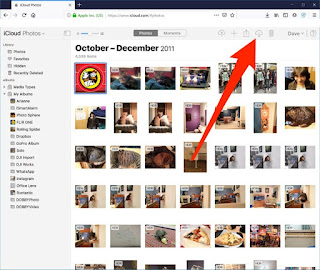
Scroll down a few pages to the “How to download photos and videos from iCloud to a PC” heading. YOU DON’T NEED YOUR PHONE TO DO THIS! Yes you do, to log in with your apple ID. It will auto-load to the downloads folder and then you can move it to wherever. It only puts them into a zip file when you are downloading a group of photos. If you are doing an individual file it will save it in the downloads folder as an individual file.
In iCloud, you may get a screen that only shows one photo at a time, not a gallery. Hit the back button and un-zoom the photo and you should see all the thumbnails.
Make sure you download in highest quality under upper right to the three dots more options menu. The HQ photo thumbnails will say HEIC. You cannot wash or convert a photo if it is in a ZIP file. It Must be first removed and put into a new folder.
How to download photos and videos from iCloud to a PC
As long as you are using iCloud to back up your iPhone, it only takes a few clicks to download some or all of your photos to your computer.
1. In a browser on your PC, navigate to iCloud.com and log in with your Apple ID credentials when requested.
2. Click the "Photos" icon.
3. Find the photos you want to download. You can click on an album or scroll through the entire library. You can also switch between the "All Photos" view and "Moments" by choosing "Photos" or "Moments" at the top of the screen.
4. Click the photo or photos you want to download to your PC. To select several photos, hold the CTRL key while you click to multi-select photos. If you want to download all your photos at once, press CTRL+A. You should see the number of selected photos indicated in the upper right corner.
5. Click the Download button at the top of the screen. It's shaped like a cloud with an arrow pointing down.
Click the Download button at the top of the screen to download your selected photos or albums. Dave Johnson/Business Insider
6. In the dialog box, choose where you want to save them, click "Save File" and then click "OK."
After selecting the photos you want to download, click the Download arrow to save them to your PC. Dave Johnson/Business Insider
You can find the photo (or photos) in the location where your browser stores downloaded files.
PROGRAMS TO COPY PHOTOS & VIDEOS TO PC
“CopyTrans Photo” allows you to “import all photos or specific photos or albums to your PC” (emphasis mine). This is important because many programs only “sync”all your photos to your computer, which is not what you want. I don’t know if it is any good.
Cost is $19.99. They also have a “7 pack” with 6 other iPhone programs, including “CopyTrans Cloudly” below.
There appears to be a free trial version of CopyTrans Photo, not sure about the other 6 programs.
They also have a program called “CopyTrans Cloudly” that is somewhat similar, but it copies from iCloud to computer. However, it only syncs your full iCloud photos & videos to your computer, not selectively, so you can’t choose which photos & videos to copy, it just does all of them. It is also $19.99, or it is included in the $29.99 “7 pack.”
Sounds similar to CopyTrans Photo above, it can copy photos & videos from iPhone to computer, or computer to iPhone.
Their webpage says you need to have iTunes installed on you computer, even though you don’t use iTunes. (I guess that behind the scenes DoTrans is using iTunes on your behalf, saving you from the hassles of using iTunes, but that is just a guess.)
It does allow selective copying, which is important.
It supports copy via WiFi, but I expect that a USB cable is a LOT faster.
It is more expensive, $59.47 for lifetime license. (They also offer a 1 month version for $24.46, but that seems stupid unless you know you will only use it once.) There is a trial version.
Not impressed with their demos, no audio, most are too short, no overview. Maybe it is because they are German and don’t speak English? Given how poor their demo is, skip.
======================
EaseUS
Sounds like it is strictly a backup, like a sync, but no option for selecting individual photos, videos, etc.
Three Pros Join My Table at The Little One for One Drop
The first time I saw the World Series of Poker, it was just after Chris Moneymaker had won the 2003 Main Event, thereby giving the average Joe the all-in inspiration to follow his dreams. ESPN made the WSOP Main Event (via the narration of Lon and Norman Chad) a national soap opera, if not an institution. Which oversized character: from Phil Hellmuth to Phil Ivey to Scotty Nguyen to Daniel Negreanu to OMG! Jamie Gold, would assert their will over the table?
To the casual poker player, no matter how hard you try to feign indifference, the thought of sitting down with pros like Phil Hellmuth, Antonio Esfandiari or even bad boy actor, James Woods, is an intimidating “big day in your life” prospect.
There are no figures for the total number of poker players who have ventured to Vegas to play in any event at The World Series of Poker. But it’s probably a far smaller amount than the number of talented players all over the world who haven’t. I’ve attended the Main Event every year since 2007, but only as a railbird, an amateur photographer and writer/blogger with a nice camera. I’m not a great player, but I’m decent and can enjoy nice runs where I do more than break even on tournament buy-ins. This year, I decided to get my feet wet and play the WSOP for the first time, in a $1.1k donkament (the very fun), Little One for One Drop tourney, the last event on the 2017 WSOP schedule.
Registering for these is easier than I thought. If you want to avoid the lines and spend more time relaxing before a tourney, you can deposit your buy-in via a website like Bravo Poker Network. Basically, they serve as the middleman so the Rio doesn’t have to multitask with verifying financial information. If you wait until the day of the event, you’ll have to pay cash to get a seat.
$1,100 to play sounds like a lot of money. And odds are 80-85% that you will never see any part of it again. But if you’re a first-timer, you are paying for the unique experience of being part of a WSOP bracelet event. Even if the maniacs at your table are playing like it’s an All-in or Fold tournament.
I arrive at my Rio hotel room the day before and go downstairs to swipe my Harrah’s Total Rewards card at a kiosk and print the ticket and receipt for the Wed. July 12th flight. There’s a special sense of pride and relief with that final commitment, holding your first WSOP buy-in receipt. One more thing you can check off that bucket list.
If it’s your first WSOP tourney, this receipt goes into the scrapbook.
Since you’re here the day before, it’s helpful to scope that day’s flight and gauge the feel of the tournament and surroundings. If your seat is in the chilly Pavilion Room, “bring a parka” is the standard half-kidding line everyone says. For whatever reason, the play I saw on preview day didn’t feel that big or monumental. The vibe was similar to any heavily promoted weekend tournament at Commerce or The Bike.
But the great thing about Vegas, is that any casino will feel friendlier and happier than the desperate card room mausoleums of L.A. Vegas is about fun. This is your vacation, even if it’s your job. If sitting at any poker table stresses you out, you are not having fun. And to quote John Hesp, the lively fourth-place finisher at the 2017 Main Event, “We’re all here to have FUN!”
As of 6 pm, 21 hours before event start time, only a meager 27 players had registered. That’s because the vast majority of the thousand-plus players at any given flight don’t sign up Online. They just sort of show up. In this year’s Little One for One Drop, some registered very late, having just been knocked out of the Main Event down the hall. These stung players can be on full tilt (like Mike Dentale next to me – more on that later). With money fresh from the ATM, they are known to plop down at half-full tables and precede to raise 6x with J-9s.
The Day of the Tournament
We start six handed, which is fine with me. All around the vast, airport-hanger sized auditorium, players are gradually filtering in, dropping their paid receipts in front of dozens of dealers. I don’t notice the intense guy, about 35, who drops his receipt next to me, until the thermal-papered name of Ronnie Bardah leaps from the table. Double-checking on Google, I confirm that Ronnie holds the stunning record for consecutive Main Event cashes, at 5. (He was also bluffed off a hand by Miss Finland in an infamous “Shark Cage” Youtube clip.) Thankfully, Ronnie is sitting directly to my right.
I am first to mention how impressive I thought Bardah’s consecutive cashes were, simply for their amazing testament to a player’s endurance and survival instincts. As the ice breaks, the table ignites in conversation. The aggressive-playing Asian restaurateur, who had raised the first six pots in a row by 6x, tells Bardah he was born in Heifa, Bardah’s home town in Israel.
Bardah’s enthusiastically sincere responses and manic high energy are infectious and suddenly this feels more like a poker party home game than a WSOP event. It’s obvious I have been lucky enough to draw the most social table of the year. Everybody laughs when an older Midwest guy on the opposite end announces loudly. “If you’re HERE at the World Series of Poker, and are worried about anything, stop now. Just the fact that you are in this room today means your life is pretty damn good!”
Given the choice of playing at a table of moody nobodies, I’ll choose playing next to a pro like Ronnie Bardah with a fun personality.
Watching Bardah’s decision-making process is illuminating. You can feel the precise and deliberate manner when it’s his turn to act. He’s not tight, but he’s observant and cautious, the trademark of a solid pro who has made cashing at tournaments his business. Attempting my best poker blog-editor FAQ style, I ask him, “Are the odds about 50% that players who recognize you either lay down hands to your celebrity rep, or bluff you for the same reason?” He stops and thinks for awhile, not sure if I am maybe angle shooting. “Yeah, that does really happen all the time,” he says. He looks over his shoulder and grins. “I suppose you could ask this guy the same question.”
The chair to my left is yanked out by a thickly-built and fearsome New York pro named Mike Dentale. Mike and Ronnie are well-known felt gladiators and good buddies. But Mike is not feeling particularly stable at the moment. He’s just been knocked out of the Main and feels like gambling up with attitude or re-buying. His massive biceps immediately become a personal space issue and I politely ask if he can scoot over. He politely responds that he is sitting to the right of the W in the WSOP table logo, which is proper. I concur and realize that further discussions will not be fruitful.
About this time, the first major hand of the day occurs between Bardah and a guy two seats to his right. This kid is in his mid-twenties, looks a little like James Franco and appears to work in music, maybe a rapper/producer. He’s very aggressive, opens plenty of pots and doesn’t give up easily on a hand.
The board is K-K-K-A-4. It’s heads-up and the kid puts in a huge river bet, two thirds of his stack. Bardah obviously has an ace and proves so by tanking for a full three minutes. It’s real simple, The kid has a king for quads or he’s got total air. The kid calls the clock on Bardah, prompting Bardah to Hollywood a bit and fold. Now the kid has his own “I bluffed a pro” story to tell. Especially after one of the other players informs the table that he folded a king.
This hand leaves Bardah pretty short on chips. It’s folded to him in the SB. He completes. I have him covered and shove in the BB with A-10h. He calls with A-Q. A 10 drops on the flop, but runner runner jack and king complete his straight on the river. A few hands later, I raise big with A-Q and Dentale shoves on the short stack with 10-10. Ace on the flop is good for me, but a freakin two-outer 10 falls on the river for his set.
I’m texting to my friend from the table. “O.K. I cannot be getting coolered if I’m stuck between two pros!”
Dentale and Bardah share war stories about the worldwide poker circuit. They talk new women, new cars, new houses, new beginnings. These are men in their prime zealously living the good life. They energize everyone around them. What had been a fairly loose table goes crazy. Two players go all-in and a third calls with A-3 suited. Players stack off with middle pair and a flush draw. At times, Mike Dentale does not appear to be looking at his cards. It feels like those old Lamborghini freerolls on PokerStars. I remind anyone who’s listening (they aren’t) that yes, it’s a rebuy structure – but at one-hour levels, why are you so reckless with 60 big blinds? I’m texting “WTF?” to my friend and he’s advising to remain patient and wait for the right spot to open-shove.
Just as hand reporters arrive to chart the action and the mood cannot be more surrealistic, Chris Moneymaker sits down at the table. He nods warmly to me and proceeds to devour a large salad in about 60 seconds. Nobody says a word to him. It’s like the most influential poker player in history, the reason many players are here today, isn’t really here. Moneymaker has never fit into any poker player cliques and remains an outsider who is unfairly criticized for being a one-hit, 2003 Main Event wonder. He’s not a particularly warm person, like a Daniel Negreanu, but he is still deserves to be treated more as an equal and less like an alien. But he is Chris Moneymaker. He will always be lonely in a crowded room and never the same as anyone else.
If you have to get knocked out at the WSOP, having Chris Moneymaker do it somehow seems cooler.
We are soon approaching the break and I’ve been grinding for four hours with bad cards while losing coin flips. I look down at only my second pair of the night, pocket 2’s. The action is folded to me on the button, I go all-in with only eight big blinds and with the levels about to go up. Dentale in the SB calls with A-9 and Moneymaker in the BB snap squeezes with Q-Q. Several empathetic players actually groan on my behalf and I stand up and nearly flop forward on the table in disgust.
Moneymaker’s hand holds and even fills up on the river. I am out. I ask him jokingly how many players he’s knocked out in his career and he smiles wanly. Bardah leans over to shake my hand first. “Buddy, loved your observations. Really, really fun to play with you!” The other players are friendlier than any L.A. casino could hope to be and we chat a bit.
The Rock Star Fantasy Camp experience is over. Instead of wondering what could have been, I am grateful not to have made a single bad decision at the table. It was an awesome afternoon of poker dude bonding that made the trip worthwhile. Two days later, I’m back in L.A where I final table cash for the third time in a row at my tough, five-table poker league. Thanks for the spark, Vegas. It was F-U-N. See you next year.
The Main Event (A Postscript)
With one day left in my short Vegas stay, I head down to the Amazon Room on Thursday night with the Nikon to pick up where I left off last year, shooting player photos at the Main Event. We are approaching the bubble. There are somewhere in the neighborhood of 1,200 players remaining. At about the 1,000-player mark, the WSOP closes up for the night and those lucky 1,000 get to claim a cash at the biggest poker tournament in the world.
Ten minutes in and I strike gold at Sofia Lovgren’s table. Sofia is a twenty seven year-old Swedish poker pro with 12 WSOP cashes. She’s one of the reps for 888poker, is ranked 1,964 on Hendon Mob’s Global player rankings and 184th in popularity. That large gap between her player ranking and popularity is due in no small part to her charm, classiness and drop dead good looks. This combo makes it nearly impossible to take a bad photo of her.
Sofia Lovgren at your table, good. Her mountain of chips not so good.
Lovgren has just changed tables. This is apparent because thirty railbirds follow her to scramble for viewing positions as she moves around the room. She is finally escorted to her seat. In her hands is a very large bag of chips. A table full of distracted men snap to attention in that way that poker players pay attention when a huge chip stack is moved to their table. Gingerly, she unloads the bag and spills the contents gently, apologizing for the mess. Sofia will wind up placing 322 out of 7,221 Main Event players for a nice payday of $35,000.
I move around a bit and soon encounter Marcel Luske, a dapper and worldly 64 year-old Dutch player who has 33 WSOP cashes and wound up 23rd this year in the Main. I have struck up conversations with Marcel on many occasions. He is always polite and gracious. Tonight I watch from over his shoulder while he bombs scary boards and takes down pots without showing.
A few tables over, I encounter a gentleman by the name of Iverson Cotton Snuffer. Snuffer, who looks like a jazz musician, is roughly the same age as Luske and holding court over a table of young-un’s. He complains that the 11 a.m. start times (after 12 hours on the felt) unfairly favor poker youth. He takes down four pots in a row, two at showdown, two because nobody wants to screw with him. He has several huge stacks of orange 5,000 chips and wants everyone to know he’s writing a book on poker and his crazy life. I confirm that Snuffer has been killing it at big Vegas tournaments this year. Five straight cashes listed. $9.1k in buy-ins and $52k paid. This was before the 2017 Main Event where he finished in 96th place.
Dutch Boyd @ 2017 WSOP Main Event. Rumors that the former lead singer of The Doors is alive and playing poker are untrue.
Finally, with the tourney clock ticking down and ten minutes left before the rail is cleared, I run into Dutch Boyd. Along with Moneymaker, Dutch was hugely responsible for the poker boom by inspiring so many kids to believe they could build a life (and a bankroll) by grinding away on Online sites. Dutch has been praised and loathed – his group of player buddies, nicknamed the Crew, were great for TV. Dutch tried to bluff Chris Moneymaker in a huge pot at the 2003 Main Event. It was bold but unsuccessful, like many of Dutch’s poker business ventures that left investors and those who had deposited money on them out in the cold.
Dutch struggled with psychiatric issues and was briefly hospitalized in a mental institution. But he has survived and continues to score here and there, recently making a deep run at a Venetian final table. But tonight, Dutch is barely recognizable, with a full beard and wrapped in brightly colored scarves. Resembling a slightly rotund Jim Morrison and holding 4-6, Boyd hits a straight on the river. He leisurely throws out a few chips and is reluctantly called by a timid opponent who Dutch glares at like an annoying bug on the Terminator’s windshield.
I walk from the Amazon Room back to my hotel room, a distance of five long blocks, all within the same hotel. I stop for a minute at the WSOP gift shop to check the hoodies, but the inventory was cleaned out weeks ago and all they have left is small and 4x. The next morning, I drive back to L.A. on 12 hours of sleep in three days. It had nothing to do with nerves or Vegas. I never sleep anyway. But something about this too-cool trip made staying awake worth every minute.
It’s a Wednesday night in L.A., and you and a buddy decide you want to play poker. With no home games available and only $150 each to spend, you inevitably wind up in one of those dreaded $40 buy-in, $1/$2 casino cash games, the kind your Mom warned you about. The rake per pot size is ridiculous and the players are mostly awful calling stations who will misplay their way to suck outs and ruin your evening.
But all hope is not lost. There are strategies you can utilize at $1/$2 cash games that will confuse and frustrate your opponents and give you a better chance at walking out with a nice profit at night’s end. Players at this level usually fall into one of two categories: the robotic, loose-weak callers and the hyper-aggressive table bullies. Both types of players will drive you nuts if you let them.
$1/$2 Cash Games with $40 buy-ins and their effective 20 big blind stacks are the equivalent of the later stages of tournaments. Players feel the need to double up quickly and gamble. Nobody is deeply stacked and calling any large raise can put half your chips in play on a single hand. But there is obviously one crucial difference in structure. It’s only $3 an orbit to play and you don’t have the blinds breathing down your neck. So slow down and take your time. There’s no hurry. Get a feel for the table and then adjust your play to exploit your competition by lowering the variance and isolating the weaker players.
In the same manner that one wild player can turn a $1/$2 cash game into a flurry of skill-less coin flips, a solid and methodical player can slow a table down and force other players to get in line. You do this first by being more patient than anyone else and seldom limping. When you do enter a pot, do so 75% of the time by raising no more than 3x the big blind. This accomplishes two things. It puts you in control of the betting by keeping the pot smaller and serves as a blocking bet to discourage maniacs from opening every pot with a raise of ten times the big blind.
These blocker bets are not as transparent as they may seem because you are not playing every hand, and it makes the table respect you as a player with a plan. By keeping your raises small, consistent and relentless, you debilitate and wear players out. Smaller pots are less of an incentive for aggressive opponents to 3-bet with marginal hands because they are risking more chips to win less money. Some may call this an overly-conservative, Phil Hellmuth-style of poker. I prefer calling it Daniel Negreanu poker because your primary goal is to get inside other players’ heads (and hands) and accurately predict whether you are ahead or behind.
Of course, the better players and bigger stacks will eventually sniff out this small-ball strategy and 3-bet back, probably with an ever-widening range of holdings. Unless you are dealt a monster, have no fear of looking weak by folding to these 3-bets. You can’t afford to lose large chunks of your stack by calling more streets when your J-10 suited misses the flop. Wait until these aggro-types get careless and then set one big trap when you finally get the goods. This is where you act as if you’re chasing and tired of being pushed off hands – while you check/call two streets and then jam the river with the nuts, like some hopeless donk with no other choice but to bluff.
Fortunately, there are a ton of grossly mediocre players at $1/$2 tables and you should be pounding these players and raising properly to isolate them heads-up when in position. This is where you accumulate a stack. Horrible players have little concept of position and overvalue their hands. Fancy plays are a waste of time. They make their holdings obvious by continually chasing bad flush draws and sticking around. When facing these loose-weak players, betting to protect your hand will not work because they will call and the pot will continue to inflate. You’ll invest more money at greater variance, risking that your stack will be crippled by some cooler river card. On the plus side, minimizing losses is easier, because you should be able to read 75% of their good hands by the turn.
It is a fallacy that only solid players are intimidated by scary boards. You can semi-bluff bad players plenty as long as you appear to be playing tight and aggressive while freely showing down winning hands when they muck. Mix up your betting patterns and weaker players may grow fatalistic and give up quite easily. When an ace drops on the flop and is checked around, weaker players will often fold to your turn bet in position. They start to believe you have them beat every time. Suddenly you’re getting fold equity and auto-folds. The calling stations have come to the grim realization that they can’t outplay you post-flop and it’s no fun, even embarrassing, to keep calling with the worst hand.
The quality LAG players are another issue. Hopefully, your table draw will be decent enough that you don’t have more than a couple at your game. Let them keep knocking each other around while they trade chips back and forth and drop bills for rebuys till they are tapped out. You are in the zone and just grinding. There is no shame folding small pairs to any large pre-flop raise against these guys. How many streets do you want to pay off while set mining against the odds? Remember the old adage that a bet saved is a bet earned.
Reading body language is one of the most written-about poker subjects, but it cannot be overstated, especially at lazy $1/$2 games. I have been at tables where half the players slump and are ready to muck their cards before the action is anywhere near them. Even better players can exhibit huge tells when they shrug as a scare card hits the board. You should be working hard to keep your motions methodical. Watch the 2014 WSOP Main Event three-handed on YouTube. Study especially Felix Stephensen and Martin Jacobson and observe what genius poker with zero physical tells is all about.
Felix Stephensen gives off few physical tells at a poker table
With sophisticated players you can employ reverse tells. One nice reverse tell is to appear awkward with your chips (easy for me because I learned to play poker online). Act as if you can’t get chips fast enough into the pot and you will look like an obvious amateur who is strong, even when you have no hand.
If you’re on a mini-heater and look down at J-2 offsuit, pick up chips and without looking affected, hold them like you are sincerely trying to calculate what amount won’t be too big a raise. Frequently, opponents will muck their cards before you announce “raise.” When a scary flop of paint falls, stare at it like someone just handed you a thousand dollars. Then fake composure and check. On the turn, put out a small to medium “value bet” and villains will groan and fold with lines like, “Buddy, what did you hit on that flop?” A smaller bet here will often look very strong to a better player who figures if he raises, you may shove. Then, when you do get a giant hand, play it the same way, only this time, jam him if he raises. I have seen players punch the table and knock over their chair and storm off when this happens. (Just avoid them in the parking lot afterward.)
Also be observant of players who are impatient and have already added-on multiple times. Avoid speculative pots with them because they’re looking to gamble and score big or go home. You have spent several hours building your stack from $40 to $200. Don’t let drunks or desperate players bring you down to their level. This is not a tournament. You have 100 big blinds and they are mentally on the ropes. As for the players who appear to be on their last go-around and are short on chips, treat them as you would any short stack tourney player. Don’t get too out of line as they will tend to shove over your routine small-ball raises.
To some readers, these strategies may seem contrary, even nit-like to the Wild West feel of a low buy-in $1/$2 game. But if you truly love the skill aspect of poker and hate the flipping coins part, think hard about playing against the table flow. The fewer the showdowns you see while building a stack, the more you are playing real poker. Try to go for hours without going all-in. Small stakes cash games are not tournaments and there is no pressure to chip up or go home. You have all night. You are a grinder and proud of it.
The Los Angeles area boasts dozens of top-flight poker leagues – including the L.A. Rounders circuit, Moose and Puffington, to name a few. But even in that crowded field, the Silver Lake Rounders poker league stands out as special. Founded in the mid 00’s by Nelson Handel and currently run by savvy tournament director David Hatfield, Silver Lake Rounders is a player-friendly environment with remarkable camaraderie and support that borders on a family home game. Many of SLR’s core group of players (about 30 men and women) have been regulars in the league for over five years and attend monthly tournaments with the consistency of the sun rising in the East. One of its members, Matt Salsberg, is a 2012 World Poker Tour bracelet winner.
If a casting director was looking for someone to play the role of a seasoned tournament
poker player, it would be difficult to find a guy with better credentials than John Romano, who’s been a dominating presence at Silver Lake Rounders since 2006. A New Jersey native, Romano’s booming voice, quick wit and outsized personality make him a showroom type player. If he were a big-name competitor, any TD would gladly put him at a front table to juice the game. He is often sitting next to an enormous mountain of chips, and it’s a given that he’ll wind up near or at every final table.
In 2009, John began making regular trips to play tournament poker in Vegas, often at The Venetian. Every year since, he has increased the frequency of his visits and consistently runs well in the $400 - $600 deepstack tourneys he prefers. Romano does not consider himself a professional and says he plays the game for fun and the competition. That caveat aside, the term “professional poker player” was surely invented to include anyone who plays for money and consistently finishes ahead. Romano rarely plays cash games, enters about 40 tournaments a year and still turns a profit. Semantics aside, the dude is a pro.
Acrossthefelt recently sat down with John Romano to discuss strategy and how he approaches the bigger field deepstack tournaments.
ATF: How long have you been playing poker?
JR: I've been playing on and off for a long time. I discovered online poker first because it was everywhere. I just got caught up in that. It was a few years before I actually played live. The first live tournament I won was a $48 entry at Treasure Island in Las Vegas. I beat a bill collector heads up with something like Q-9 against A-K. That alone was enough to make me realize how cool of a game Hold'em was. Now, I think back to the online days (before the poker prohibition) and I was always getting rivered in some sick beat. It seemed impossible to bluff anybody. Sometimes I’d take the full amount of time on the clock just to irritate people.
ATF: How many days/hours a week do you play?
JR: I play as much as I can, unless I hit the wall, which happens every six months or so. Then I take a month or two or three off. Training for tournament poker is like preparing to compete in any other sport. My whole poker year is based around being in sync with the game around June.
ATF: If someone is walking in off the street into a casino tournament like the Venetian Deepstack, what do they need to be thinking about on Day 1? What are your tips for survival early on? What mistakes does a player need to avoid?
JR: For me, Day 1 is the easiest day of the tournament. It depends on the structure, but most big tournaments have a very player-friendly opening day. The Venetian Deepstack events have 40 or 60 minute levels with 15k stacks. Day 1 is basically designed for good players to survive. The key is to realize you have plenty of time to play. Even if you get knocked down as far as 25% of your original stack, with the blinds still relatively low, you can battle back. A player might look at their tiny 5k chip stack and then glance at the growing stacks of 25k or 50k around them and get nervous. I've played tournaments down to one big blind. I didn't come back to win, but you can go much further than you think. Patience and experience play a huge role.
ATF: Once you’ve paid your entry and the cards are finally in the air, if you’re dealt A-A in early position on the first hand, are you ready to ship it right there?
JR: A-A in the first hand? If you raise pre-flop and someone goes all in, you should be ready to risk it all if necessary. Of course, if you slow play A-A on the first hand of a tournament and the flop is 8-5-2 and the big blind immediately goes all in, you better fold.
ATF: Let’s say that you’ve survived Day 1 and are bagging up your chips. Do you log your hands or discuss situations you were in with anyone else to compare notes? Do you look at the things that worked and didn’t work to adjust strategy, or is it more of an autopilot thing?
JR: David Hatfield (TD at SLR) is someone who I discuss strategy with often. We have very distinct and different styles. He is much more analytical than I am, so I like to hear his perspective on the game. If you can make Day 2, you are usually down to 1, 2 or 3 tables. By then, you have your seat position, chip counts for your table and the Internet player databases like Hendon Mob and Poker Pages where you can see if you are dealing with experienced players or newbies. When David and I have analyzed things, a lot of times we are talking about where the tough players are and where the bigger and smaller stacks are located. You can look at stack size relative to the blind structure and see who might be shoving light and who might be playing big stack bully.
ATF: Since you are playing shorter levels at these, where do you draw the line between having patience and playing too tight?
JR: Hatfield and I talk about this often. We agree that sometimes the typical strategy of shoving light late in a tourney before you get below ten big blinds can get you in trouble. Patience pays off, but only with other relatively short stacks around you. Instead of any medium ace in early position, you might wait for a bigger ace or a pocket pair of at least 5-5 before shoving. By the time you start Day 2 in a mid-sized tourney, it is pretty late in the game, so there is a lot of volatility. With so many chips moving around, you give yourself a higher percentage of cashing by waiting.
ATF: How much of your play is by feel and how much is crunching numbers? You have a lot of success. I would think you have the math down. If a “feel” player can only remember simple math at tourneys, what do you recommend?
JR: If a player has a rudimentary understanding of pot odds and knows the basic chances of completing a hand they can do well. Study up on those things and you'll be good. Pot odds is the most important concept but you don't have to be a professor at it. If you are playing late in a tournament, at the 5k-10k level, and have only 40k in chips in the small blind with 7-3 offsuit, and five other players flat call, it might be worth it to complete your small blind for 5k! The math is simple, 5 players plus your small blind, plus the big blind equals 13-1 odds. The odds over time favor experienced players who look for "odds mistakes" and take advantage of them.
ATF: What are your best recent tourney results?
JR: Last month, I placed 10th in one of the Venetian Deepstack events. But an experience I won’t soon forget happened in a $600 Deepstack at the Venetian during the WSOP last year. On the third hand of the tournament, I made a huge mistake and donked off 90% of my stack. I sat there for the rest of the day and resolved not to play anything but A-A, K-K, Q-Q and A-K suited. I cashed in 21st place in a very big field. 12 hours of play and not once did I have more than an average stack. Actually, I was under ten big blinds for at least six hours that day. So far, I've yet to win a large tourney, but that’s what all of this hard work is about.
ATF: What casinos offer the best structures?
JR: I prefer playing in Vegas far more than anywhere in Los Angeles. I like the Hustler in LA best. It’s a tad smaller than other rooms, but is run very, very professionally. I also like Commerce Casino. In Vegas, I hit the Venetian, Wynn, Caesar's and Bellagio.
ATF: It does seem like you make a lot of trips to Vegas to play. How many times do you go out per year? Is it just you on a plane, like the traveling businessman with his schedule all planned out?
John Romano
Photo: David Hatfield
JR: I play poker in Vegas seven or eight times a year, usually around the Venetian's Deepstack events. The hard part comes when you aren't playing poker. Besides the obvious temptations, Vegas is a very lonely place to be solo. I stay in touch with friends quite a bit via Facebook and the phone when I'm there. Being from L.A., the commute to Vegas is easy. I don't think I'd go very often if it was a ten-hour drive instead of four.
ATF: Sounds like you really enjoy the deepstacks in the $400 to $600 range. Do you practice formal bankroll management?
JR: These days, I’m concentrating more on smaller buy-ins and playing more of them, at least 40 a year. I don’t practice any specific bankroll management. I keep the numbers in my head. But I have been treating it more like a business every year and my results continue to improve. When I play Vegas, I do less of other things and even more of poker. Instead of automatically staying at the Venetian, I will go up the street and get a half price room at Treasure Island because I’m more aware of expenses. But yeah, the $400 to $600 tournaments can offer an insane return on investment. The Rio has these tourneys going on at the same time as the WSOP. $200 buy-ins, 20 minute levels and first place walks away with 31K.
ATF: How much of your time is spent playing tournaments as opposed to cash games?
JR: When I first started playing poker I rivered a full house in a cash game at the Imperial Palace in Las Vegas and ruined this guy’s day. Ever since, I've gravitated toward tournaments. You beat a guy in a tournament you knock him out. In cash games you can take some dude’s rent. Not exactly how I like to play. I do play cash in Vegas from time to time and I tend to play fast loose and aggressive. Cash players use so many skills; it’s great to step onto the killing field of a cash game to tighten up my short game. Cash, to me, is more like a sprint, while tournaments are long distance races. The WSOP Main Event is the ultimate test. With tournaments, everyone starts with equal chips. A tournament is a sport. It’s about the passion of the game. I equate tournaments vs. cash games like sports vs. money.
ATF: How do you handle the boredom that can come from 10-12 hour days at the tables?
JR: I don't get bored. Sometimes impatient, no doubt, but I always love playing. Music helps. On rare occasions, I'll have a few beers depending on the game. Tournament poker is hours and hours of sitting and folding. You’ll go from doing nothing for an hour, to all of a sudden, it’s like somebody flipped a light switch – now you’re on and the light is on you. A minute later, the light switch is off and you’re back to standby mode. You have to be able to mentally flip back and forth like that.
ATF: When you sit down at a table with a bunch of players you’ve never seen, what things are you looking for to clue you in on their playing traits and typical hand ranges?
JR: Really, I focus more on a players betting style than hand range. Figuring out how much pressure can be applied to an opponent is very helpful. I always tell novice players to fight back when they are pushed by more experienced players. Don't go all-in unless you have the goods, but don't be afraid to raise a more experienced player when they bet into you. It matters.
ATF: All players go through periods where they are completely card dead and must steal here and there or their stack will evaporate. What situations are you looking for to do this?
JR: Timid players are great to steal blinds from. Especially if you have a lot of chips or haven't played a hand in awhile. It really comes down to being in any situation where your opponents are least likely to think you are bluffing.
ATF: Care to share any thoughts on how and when to bluff? Without giving too much away, how often do you do it and how do you do it around players you’ve never seen?
JR: Bluffing is a huge part of the game when used sparingly and effectively. It is an art and it’s about opportunity. I equate it to trying to meet a pretty woman at a party or night club. You have to move. Ten minutes later, she can be talking to a different guy, with friends, or she’s left the party. Bluffing is the same way. When the opportunity to bluff arises you have to be bold, brash, and resolute. The longer I play, the more bluffing becomes an innate skill. In any case, you can't bluff too much or eventually you'll have no chips. If you don't bluff at all – you'll also eventually have no chips. As long as your bluff isn't an all-in, what is there to lose? The best part is when an opponent knows you are bluffing but can't bring themselves to call and find out.
ATF: I notice that you seem to play a lot of hands and will check/call frequently to see another card. That can be expensive. What happens when you miss in these situations?
JR: Poker is a game that is meant to be played. So many times players get hung-up on waiting for A-A or K-K. Conversely, other players don't wait at all and treat each hand like a lottery scratch off that can't be folded. The trick is to play a lot of hands to keep your opponents off balance. At the end of the day, when you call a final bet on the river, you want your opponents to be surprised at whatever hand you turn over.
ATF: The best players seem to know when they are good, even if bottom pair is enough to take down the hand. What reads can you rely on with players you’ve never seen before?
JR: I play a lot of hands to the flop and turn because I want to mask the fact that I'm looking for the golden hand. For instance, I raised 3x the BB in a game last week with 6-7 offsuit. The flop came rainbow 4-5-8. I destroyed a player’s night with that hand. He kept betting and I kept raising. Finally, on the river I went all-in and he folded. Unfortunately for me, the river was a king and I'm sure he put me on K-K or A-A, so he folded, but he was weakened greatly. The only reason that gambit worked is because I folded ten other hands after the flop or turn. Really, playing before the flop is simple math. You have great cards, you go in. Or you bluff with bad cards to set a player up for later, but the game of poker actually begins with the flop.
ATF: Everyone cringes when a couple of maniacs join a table and immediately begin 6x raising every hand pre-flop. Nits are easy to deal with. But how do you handle the drunk kamikaze guy to your left who seems to be the evening’s luck box?
JR: Try and call as many hands as reasonably possible against such a player, because when you hit they are guaranteed to go all-in against you. Six-timers don't usually last to the end, but they tend to create a lot of carnage on the way. Sometimes they just keep steamrolling, but eventually they overplay their hand and get knocked out in most cases.
ATF: Are there certain players who you will avoid playing pots with?
JR: No. Some people I find harder to read than others, but the trick is making sure you never let on that a certain player bothers you or has your number, so to speak. Avoiding becoming the target is very important, unless you want someone to focus on you. Playing dumb in poker is a great way to take someone's entire stack if they aren't careful.
ATF: I know that one of your favorite subjects is bubble play strategy. For a lot of players, this would be a good problem to have because they seldom get that far. Do you punish the nits who just want to cash?
JR: Playing the bubble is the most important part of the game of poker. Fear plays a huge role in how players approach the bubble. I've learned that the bubble is to be ignored as best as possible. Given that fact, yes, you need to make the timid pay, because getting through the bubble as fast as possible is very important.
ATF: If your stack is short, can you really do anything else but shove/fold? In other words, what stack size relative to the blinds is that point where you draw the line that this is a ship or fold as opposed to risking a portion of your stack?
JR: If you are very short stacked, under ten big blinds, with say, three players left to the bubble, you'd be shocked at how many hands you can play before having to go all-in. I've been in games with ten big blinds on the bubble and watched players with 35 big blinds crack and go all in with 2-2. The key to bubble play is accepting that you may go home inches from cashing, but if you play strong on the bubble you can set yourself up to win the tournament.
ATF: I like the description you gave to this. You call it the “active bubble” stage.
JR: I've noticed over the last few years that the more active a player is as they approach the money bubble, the more chips he/she has once the bubble bursts. If you are ridiculously short-stacked, then hang on and hope your opponents die on the field of battle around you. If you have chips, take advantage of the fact that many players will sit on the sideline. This was reinforced to me the hard way in a recent Venetian tournament. I mellowed my play to guarantee a cash and it hurt me greatly after the bubble burst. The big stack to my right was drinking Johnnie Walker Blacks as if he was on leave from the Navy. Had I had chips, I would have been able to take advantage of the situation. Since I had cooled it for so long in order to make the money, I was in double-up mode for hours. I finished 9th on the day, but could've done much better.
ATF: I’ve been at a few final tables with you and I’ve noticed you’re not averse to gambling. Sometimes there will be large fluctuations in your stack – way up or way down. Are there any tips you can give to tighter players for loosening up and letting the cards fly? It’s a lot harder than it sounds for some players.
JR: Many players make the mistake of confusing playing a lot of hands with going all-in. Look, if I have $100,000 chips and the blinds are $2000-$4000, what is the difference, really, if I get knocked down to $60,000? The blinds are only going to go up, so you need to play the game. Remember, the more you play, the better chance you have of trapping a player and taking their whole stack. If you were at a final table, who would you fear more? The loose guy playing many hands who rarely goes all-in, or the tight player who plays one hand out of fifty? It's the guy that is going to raise your big blind every orbit that is the troublemaker.
ATF: Is it psychologically easier to risk more at lower buy-in events?
JR: Loosening up is a function of bankroll. I never play a tournament where I couldn't laugh off the entry fee. Last month, I lost the third hand of the $400 Venetian Deepstack when I ran into the situation you asked about earlier. I had A-A and raised to $500. A player raised to $1600. I raised it to $3500 and the player went all in. It was pretty clear to me that he had A-A, K-K, A-Ks or was just a bad player. I’m ahead pre-flop in every case unless I run into A-A and then, it’s the old statistical tie. So the choice of calling an all-in is obvious. In the end, his K-K beat my A-A when a king hit on the flop. Had the entry been $4000, I may have either folded – a bad move – or been upset at losing so much money. $4000 is peanuts to someone else, but to me, it would make me uncomfortable enough to affect my play. If someone else were funding me, it would be a different story. I'd make sure the backer understood that I'd go all-in early if need be. Currently, I max out around the $600 range. Someday that may change, but that’s where things stand now.
ATF: What are the 3 worst mistakes players make at casino tournaments?
JR: Being too timid, too aggressive, or too dumb. I think that pretty much applies to every other human endeavor as well. I've been all three at different times in my life, and as a poker player. I've also been valiant and made calls, in poker and life that people thought were terrible, but I had a great read on the player/situation and cleaned up.
ATF: Ask any player the hand they remember best from a tourney and it’s the hand he/she got knocked out on. A typical problematic hand when it’s late in a tourney and you have 10-12 big blinds, is middle pair, like 7-7 in early position. Limp with other callers and you probably have to hit a set if there is any paint on the flop. Raise to 3x and you risk a shove back over the top with the guy who woke up with J-J. Go all-in and you may well run into two callers and only be 33% in a 3-way pot. How do you play marginal hands like middle pair or A-10, Q-J, late in a tourney when short-stacked?
JR: A-10 late in the game is a far preferable hand to 7-7 in many ways because of the reasons you just spoke about. The key is having a range of playable hands and positions in your head that you don't deviate from. If you've decided that you will only play A-A or K-K late, then you need to stick to that. If you've been playing 4-5 suited with some success, you have to stick with that range until you make the conscious decision to tighten up. Once you know what hands you are willing to play in any given situation, the rest is easy. Me? I fold 7-7 in first or second position short stacked almost anytime. A player with a monster stack will easily play Q-8 suited if it comes down to the two of you and I really don't need to end the game with 2-6-8 on the flop, you know?
ATF: While we’re on the subject, what hands and situations give you the most trouble?
JR: Sometimes I can get into trouble if I get too many K-J's or A-Q's or A-10's in a row. There is another couple of hands that I have problems with, but I'll keep that to myself for now. LOL.
ATF: What do you think are the major breakthroughs a poker player must make to advance their game to higher levels?
JR: Learning the mechanics of the game is the first step. Patience and aggression are next and finally, the last and most important step is conquering one’s fear of the bubble, or put in layman's terms, beating the fear of failure. Humans work harder to avoid loss than they do to make gains. It’s a theory known as "loss aversion,” and the research backs it up lock, stock, and barrel. I’ve never been much for strategy books but one incredibly useful one is Mike Caro’s Book of Poker Tells because you can use it every single time you play in any environment.
ATF: You get to see a fair amount of talented players. What is the difference between a decent, solid player and a great one?
JR: Great players have conquered "the bubble" and have less fear than other players. This may sound simplistic, but the only way to beat a great player is to play a lot of hands against them without letting them bust you. A great player has the ability to shift gears and isn’t afraid to trust his reads with everything on the line. By the same token, he’s difficult to get a read on and isn’t afraid to risk a lot of chips to apply pressure. And he is capable of laying down big hands when the situation calls for it.
ATF: Here’s my last question. If you could sit down and play a charity tournament against the pros you’ve followed and admired the most, who would be at that table and why?
JR: Daniel Negreanu, Phil Ivey, Ben Lamb and most of all, Phil Hellmuth. I'm very curious how I'd react to his tantrum routine. I hope I get to find out some day.
As made-for-TV concepts go, ESPN’s “Big One for One Drop,” was perfectly suited for these modern times – where a desperate poker industry finds itself broke, busted and de-evolving. In the wake of Black Friday, disintegrating ad sales have gutted TV poker and crippled trade magazines, while professional players leave the U.S. in droves to play overseas, or quit the game altogether. What better way to forget our troubles than with a simple, star-studded, dumb-as-doornails premise. 48 pro and amateur poker players drop a buy-in of a million dollars each and the winner walks off with a whopping $18 million in cash! (Nice Rake Caesars) Did we mention (at least the announcers did twenty times) that it cost a million dollars per player to enter this tournament? Who said there was no money left in the game?
The “One Drop” tourney was a clever gimmick – the celebrity rich and famous thumbing their noses at the dismal, collapsing poker economy. It succeeded by accident, based largely on the chemistry of the players at the final table. Several of the best pros went up against amateur players, mostly billionaire businessmen who consider a million bucks a fair price to get on national television and rub shoulders with their idols. For viewers, it was a valuable learning tool, chiefly because of the lessons learned from the weak play of the CEO’s, a live primer on mistakes to avoid.
It was painful to watch at times, especially Bobby Baldwin, the 1978 Main Event winner who plays tighter than a rock star’s pants and has yet to adjust his game for the modern era. A couple of TV hands were blatant examples. Holding middle pair in middle position and short stacked, Baldwin just flat-called an early position raise, only to be driven out of the hand by aggressive pro Sam Trickett’s button reraise/squeeze with 8-3 offsuit. Later, mega-billionaire David Einhorn raised preflop with 8-10 suited and Baldwin, still short stacked, just called with K-Q, offering Trickett (holding pocket 3’s) a great price to join the fun three-handed. When the flop of 7 4 6 missed Baldwin, Trickett assumed his pair of 3’s (with gutshot draw) were probably good and bet. Baldwin and Einhorn, of course, insta-folded. If Baldwin three bets his K-Q pre-flop, nobody in the hand would have stuck around to call his C-Bet after the flop.
These were fairly routine observations that could be made by rewinding your DVR. But nobody in the announcer’s booth bothered to bring them up because prime-time poker broadcasts on ESPN are in the final stages of terminal irrelevance. Commentators Lon McEachern and Norman Chad have anchored the “World Series of Poker” for ten years. While the game has strategically evolved by leaps and bounds, the show hasn’t intellectually budged an inch to grow with it – much to the dismay of those few real fans who still enjoy watching poker on TV.
To understand the ridiculous dilemma facing poker broadcasting in these times of prohibition is to appreciate how ESPN and Caesars Entertainment (who run the World Series of Poker), must walk an impossible tightrope. How do you promote and build a game that is basically perceived as illegal by the general public? Fearful of guilt by association, or maybe on the advice of their attorney’s, ESPN has shamefully turned its back on the brand it built so brilliantly in the 2000’s. As their major gaming advertisers (basically defunct U.S. online sites) deal with prosecution and jail, the network has pulled the plug on pre-2011 WSOP repeats, while cutting 80% of its poker programming.
But there is some good news in the midst of all this blatant shrinkage. The competition from online poker TV has grown the broadcasting game. Brilliant analysts and commentators like Olivier Busquet and David Tuchman have quietly moved up the announcer food chain, graduating from podcasts to ESPN 3. As a result, dedicated poker viewers are exposed to deeper and more profound levels of strategy, the kind of sophisticated analysis that’s an exciting step forward and a natural product of a maturing market.
When ESPN had the courage to air an unprecedented 50 hours of live poker at the 2011 Main Event, it was a breakthrough that held the promise of revolutionizing the way people watch the game on TV. While the roof was caving in on the industry, the coverage expanded. Most importantly, the network finally let real experts call the action, just like in other professional “sports” broadcasting. It demonstrated healthy ambition, but also felt like a ratings loss leader – as if someone had stolen the TV station and was doing all this innovative, fun stuff because it was inevitable that the landlord was on his way to pull the plug on the whole thing.
Poker pro and celebrity reveler, Antonio Esfandiari, provided inspired, revealing commentary, and Phil Hellmuth demonstrated that he’s a vastly underrated old-school analyst, while interminably reminding us of the respect denied him as the most successful player ever. But the 2011 live WSOP extended coverage was mostly about Olivier Busquet finally getting his shot at a prime-time slot. A New York City native, the 31 year-old Busquet was a high school star in track and basketball and is one of the best heads-up players in the game. This was proved beyond a shadow of a doubt in 2009, when he overcame a 20-1 chip advantage to take down the The Borgata WPT Poker Open.
Busquet is the future of poker announcing, a guy with a stunning knack for translating the most complex strategy situations into a language that is not only informal but accessible for the average viewer. He’s the poker coach you wish you had – here to help the less knowledgeable, so don’t be afraid to look dumb by asking.
With a slightly pompous and academic delivery that still feels pure and organic, Busquet effortlessly brings the viewer into the mindset of the accomplished, younger poker players. He can appear nervous at times and stumble out of the gate, but once he hits stride, the rhythm and timing of his insight is staggering. Working in real time and without the benefit of the hole cam, Busquet doesn’t just describe what we are already seeing, he explains the thinking and the counter-thinking involved in every decision at the table. He walks us though the thought processes behind the action. When he’s at the mic, you’re really learning how to put a player on a hand, a skill that can seem like spiritual enlightenment when you finally get a knack for it. Busquet and his frequent partner, announcer David Tuchman, are version 2.0 of Lon McEachern and Norman Chad.
Viewers who had watched hours and hours of “Big One for One Drop” coverage live on ESPN 3 were eagerly anticipating Busquet joining Lon and Norm in the announcers’ booth, possibly as a third wheel, for the taped prime-time broadcast. But one minute into the two hour edit, it was disturbingly apparent that this was not to be. Busquet had been air-brushed out of the picture and prime-time watchers were robbed of the chance to appreciate the debut of a real star. As it has for years, the network played it safe and scared with McEachern and Chad.
One memorable example comes to mind of a hand that was called by Busquet and later by Chad in the truncated TV broadcast. Here’s why what you don’t hear is often more important than what you do.
Phil Hellmuth held Q-J heads up against David Einhorn on a board of 5 9 10 3. Hellmuth, in position, played his hand incredibly weak, checking back on every street, mandating that if he failed to pair his overcards or hit the open-ended straight draw, he must fold (by self-instinct) to any river bet. Luckily for him, he spiked his open-ender and the nuts, when a king landed on the final card. Einhorn also hit a pair of kings, an incredible break for Phil, and the amateur quickly bet 1.5 million, announcing to the world that he had top pair.
Hellmuth, with only 10.4 million to start the hand, put in a huge overbet, raising to 7 million. Einhorn folded and Hellmuth made the absolute minimum, leading the casual viewer to think this was another situation where Phil didn’t get enough value out of a hand and another reason why he’s always short stacked. But instead of paying even a passing thought to what we just saw, all Chad could offer was a semi-retarded, nonsensical cliché. “Don’t count the Poker Brat out!” he hooted.
Anyone who watched the live broadcast online on ESPN 3 heard Olivier Busquet offer a radically more profound analysis without the advantage of already knowing how the hand would play out.
Busquet said, “It’s very hard NOT to put Phil on the absolute nuts with a bet like that. When Einhorn bets the river you have to give him credit for a pair of kings. One of the ways that Phil has been so successful over the years is to get amateurs to call big bets in situations where he is rarely bluffing and this strikes me as one of those situations. This is a huge percentage of Phil’s stack and I think Phil would interpret an all-in here as looking incredibly strong and doesn’t want to lose the amateur, so he bets a little bit less to give himself a better chance of getting called. Sometimes players make plays like this to make it look like they are leaving themselves some chips, so if they’re bluffing and get called they’ll still have some chips left over to play. That doesn’t strike me as what’s happening here.”
With this added explanation, Hellmuth’s play made a certain sense. Einhorn eventually folded his hand because he wasn’t buying what Phil was selling. But the viewer who saw both telecasts didn’t walk away remembering how bright a guy Einhorn is. The viewer was left with the impression that to be denied the brilliant insight of Olivier Busquet is to feel cheated by ESPN.
There was a time, ten years ago, when Lon McEachern and Norman Chad were a breath of fresh air in a game where the players and broadcasters smelled old and irrelevant. In 2003, ESPN radically changed its WSOP coverage, upgrading the typical dry commentary with personality-driven player profiles. Chad had a knack for making poker seem like a swashbuckling, exotic lifestyle and more than just a bunch of guys playing cards. It was a poker party, a home game on TV. You could forgive Chad’s moronic Rat Pack jokes and endlessly contrived stories about his ex-wives because he really made the players at the table into three dimensional individuals. Everyone had a personal back-story, as meager as it might be. The best known players were actors in a reality sports show. Any viewer could find a player to root for. It was like casting for the Wizard of Oz.
And what a cast they had for this continuing soap opera. There was the father figure, real cowboy and beloved patriarch, Doyle Brunson; the long-haired, math wizard Chris “Jesus” Ferguson; the pontificating “Professor” Howard Lederer; his bitchy and kinda hot sister, Annie Duke; the master feel player, Johnny Chan; the impish, likeable Daniel Negreanu and the most feared player on any given day, Phil Ivey – to name just a few.
But the primary component of a good script is always the villain. Poker had the best in Phil Hellmuth, a whiny self-promoting loudmouth who just wanted luck and the poker gods to please give him a break so his true genius could be appreciated. It would be rare in any entertainment venture to find such universally recognizable and attractive figures, and their role in making the game explode in popularity cannot be underestimated.
Norman Chad fit like a glove with these larger than life personalities. He really sold the concept of poker as a good time. His comedy and frivolous nature was well suited to a naïve TV audience that was still getting used to terminology like the “flop” and needed a gravelly voiceover at the start of every WSOP broadcast to refresh them on the basic rules of the game. But as poker evolved and the fans grew more sophisticated, Chad’s limitations became more and more problematic. Lon McEachern was a jack of all trades and similar to a white dress shirt. He could go with anything and did double duty for ESPN, calling mixed martial arts bouts with the same efficiency as the WSOP. Chad was supposed to be the color guy, but was really just a general sports reporter faking it, not a poker expert. He was destined to always be an outsider trying to explain an insider’s milieu. His corny approach, vacuum sealed in about the year 1966, finds him in 2012 still referring to the younger players who have become the mainstays of poker as “those Internet kids.”
It’s been nearly ten years since Chris Moneymaker won the Main Event and those darn Internet kids, weaned on the classic poker film, “Rounders,” put the youth of America squarely at the reins of the game. But online players behind computers 16 hours a day seldom develop much personality. They care little for branding and self-promotion. Sponsorship is where it’s at. Yet ESPN continues to stick with an old-school celebrity formula that has less and less material to work with. Compared to a volcano like Mike Matusow, Ben Lamb is plain white bread. Is it possible to develop a fascinating back-story on Martin Staszko? Forgot him already? He was the Soviet Bloc guy who finished second in the Main Event last year and was best remembered for a perpetual look of fear and embarrassment, like he was afraid someone might demand a closer look at his visa.
So if you’re Caesars and ESPN what do you do? How about this – instead of repeating the past, you embrace and cultivate the future. Poker is a beautiful game, one that anyone reading this already knows. It is basic and brutal. It is sophisticated and requires ridiculous intelligence, employing strategy that can be successfully applied to everyday life. Poker is a religion that does not require you to kill those who don’t believe. It is exhilarating and overwhelming in its ability to bring forth your inner strength when the chips are down and you’re tired and beat and your back is against the wall. It tests you and rejects your best efforts – but it also rewards players for hard work, giving anyone who devotes themselves the opportunity to match wits with complete strangers in a safe and sane environment, where the green felt jungle of the poker table is the ultimate proving ground. Maybe this sounds like a commercial for the U.S. Army. But seriously, celebrities are not the key to poker’s future; they are a cover-up hiding poker’s true strengths. It doesn’t need to be hidden by make-up. It looks great just rolling out of bed. Make the casual viewer fall in love with the game and you’ll have an audience for life.
Norman Chad and Lon McEachern are celebrating their ten-year anniversary and this seems like a smart time for them to cash out for the good of the game. Their unsophisticated play by play is as dated as the generation that preceded them. Executives at Caesars are fond of whining about how abysmal the ratings were for mixed-game poker on TV – that infomercials drew better ratings than the revered $50K buy-in Chip Reese H.O.R.S.E. tournament. Long gone are the days when the goal was to educate the viewer about all things non Hold ‘em. Now it’s a grim numbers game of survival. Even before Black Friday, ESPN had turned tail and run. I spoke at length with Chad at the 2010 Main Event and he told me he nearly lost his job for demanding that the network continue its broadcasts of Stud and Omaha. I guess, in the end, this is a business and it was business decision for ESPN. But ever since the events of last April, it’s felt more like a betrayal.
For the first time ever, there were no significant pre-Main Event billboard ads on ESPN. The debut broadcast of the “One Drop” tourney was 11 p.m., instead of the prime time 6- 8 slot. You have to wonder how ESPN expects to get ratings when no one knows these shows are on. Are they afraid that publicizing poker programming in these post-Black Friday times is unsavory, or have their lawyers advised them that it would smell of collusion with embattled online poker sites if they put some muscle into promotion? It all reeks of pre-censorship and a gutless lack of commitment. ESPN treats poker like the errant mistress you’ve got stashed in a safe house across town. Profess your love for her but keep her hidden from everybody else.
Chad can’t be blamed for all of poker’s woes. But once the network gave the public a taste of what poker announcing could be, they can’t put the genie back in the bottle. A move must be made, and next year’s WSOP is the time to recreate the spirit of 2003 and break that mold. There are a half dozen color commentators who have worked various online broadcasts who are superior to Chad. But here’s a simple solution. Just get Olivier Busquet and do it now before he signs a contract with the World Poker Tour.
In the meantime, prepare yourself for another month of WSOP Main Event Coverage, 24 new episodes where Norman Chad-isms (jokes that bomb) will hang heavy in the air like wet laundry on a clothesline in the rain. While Olivier Busquet is hard at work grinding online in a remote Toronto apartment, Lon and Norm will remind us how much we need him, with “One Drop” repeats weekly on ESPN.
Brace yourself for canned straight lines from McEachern like, “The One Drop – an unforgettable night of poker for unforgettable dollars.” Prepare to suffer through Chad nimbly dissecting David Einhorn’s play with the revelation that, “He looks dressed for a day on a really nice sailboat.” Chad reminds us, “The flop has three cards” and clues us in on Esfandiari’s mindset at the table by saying, “Antonio would be a natural in outer space.” And how’s this for a curious slice of wtf babble? Norm trots out the literary references when he describes a player as, “Looking relaxed, like Thoreau at Walden Pond.” Nuff said! The viewers don’t need fancy stats like post-flop aggression frequency and money voluntarily put into the pot. Chad can just observe how younger players look really cool in hoodies and sunglasses. It’s Poker for Dummies and one-liners from a guy who sounds like he’s announcing a seniors’ dance at a Florida retirement complex.
Poker is no longer an analog world, it’s decidedly gone digital. And while Norman Chad represents the old-school analog approach, it is not analog in the sense of a warm vinyl album on a smooth turntable. It is the grating sound of a worn-out scratchy record, skipping in its groove and constantly repeating itself. The harder Chad tries to be funny, the higher his voice goes, reaching the pitch of a drunk snorting helium, while Lon does his tired “Ho-Ho-Ho” Ed McMahon sidekick shtick. Many of Chad’s lame quips are incomprehensible gibberish, because four weeks of lag between the taped event and the actual broadcast is apparently not enough time to write a decent joke.
In “The Sopranos,” men who had overstayed their purpose were described as “Guys who gotta go.” It wasn’t personal, just business. Somebody please send the car for Lon and Norm. You can’t give a nation a taste of free speech and expect them to return to a repression of intellect. Nobody would ask DVR viewers to go back to time-shifting their shows on VHS tapes. Once you’ve lost your virginity you’ll never be satisfied with holding hands. It’s over and the question is how long will it take for ESPN to make the obvious move necessary for the dignity and longevity of poker on TV?
The other day, late in a $50 for 5k in chips with rebuys tourney, I folded A-Ko twice preflop when a player shoved and I had the option to call off my entire stack and look them up. I have no reasonable explanation for this behavior. To some it would be inexcusable. My only defense is it had been a six-hour grind with a lot of skill invested in trying to cash – the only reason a person should put money into play.
A 53-entry tourney and we were down to the final two tables. I had watched aggro players donk off chips or get impatient and make loose calls. These players, who don’t shift their games to tighten up after the rebuy period ends, usually depart early. Their volatile stacks go up and down like a freight elevator and then they are gone. My stack usually put-puts along like an old VW with a tune-up – workman-like, never ostentatious. I’m very tight, but I often outlast 75% of the fields I’m in. If I can get somewhere in the vicinity of the final table and pick the correct spots to double up twice, I can walk out with a nice cash.
At the time of the A-K incidents, the blinds had accelerated to 2k and 4k, and were about to go to 3 and 6. I had 24k in chips and so did the shoving stacks in each case, but I suffered a fatigue-related brain freeze and didn’t do the stack-size math to realize I had to commit to my A-K. We were three players from the cash bubble and I had worked very hard to methodically survive with two big, loose stacks to my right and left. I figured I could look for a better spot to coin flip. Wrong!
I have long had issues with poker and the fact that so much of it is luck. I would prefer it if the game was 100% skill. Maybe it would not be as much fun, but I don’t have much “fun” with the luck part. I hate it because I am always convinced I am going to lose. Someone is going to runner-runner a flush, straight or some other crud and my pair of aces will burn in eternity. When I first started playing poker, I would go all-in the moment I picked up a big pair or better. Then I learned to slow down and get value – let the deck breathe. Give someone a chance to connect with second best.
But I never liked A-K the way I was supposed to. Factoring in fold equity, A-K was a shoving hand, not a calling hand to an all-in. I didn’t trust an unmade hand. And I certainly could never fathom how A-K unsuited was supposed to be almost 50% against a pair. I still don’t believe the math. The player with the pair doesn’t have to do anything. You have 6 outs. We won’t bring up the obvious – of where you’re at if they have K-K or A-A. But 10-10 to Q-Q doesn’t make me too happy either, as my straight draw is extremely tainted. To me, A-K up against a pair, is nearly a 2-1 dog. Period.
Back to the tourney the other night. The first shover showed Q-2s when I folded my A-K. Call there and hold ‘em and I double up to 48k and can coast to the final table cash, which would have been my fourth final table in the last six tournaments. I won’t ask what this player was thinking, shipping it with Q-2, except, “Nice work, if you can get it.” Maybe, before folding, I should have sized him up. I could have asked all those penetrating Daniel Negreanu-type questions, where you call out his hand range for everybody. Most importantly, “Do you have a pair and am I chasing?” But I have found that thinking out loud too long at the table makes me self-conscious and clouds my mind. Trying to put a single shover on a hand pre-flop is a waste of time. If he’s got the same stack as you do, take out a quarter and toss it up and see where it lands. Or make your calling decision by “the book.”
“The book,” however, is better suited for cash game players. Gut instinct and survival tactics are what win poker tournaments. It’s not easy to switch gears at the end of tourneys and allow luck to be the deciding factor. Every time someone says, “Let the cards play themselves,” I ask, “Then why are we here?” But just for the record, next time, I will call anyone, anytime who shoves into my A-K. Go ahead and make me sweat. I’m used to it.
2011 has been a year of massive upheaval in the U.S. poker world. With the closure of Full Tilt Poker, Pokerstars and Absolute Poker, many online players are looking to try brick and mortar casinos for tournaments and cash games. For some, the transition to live play isn’t easy. Just walking into a giant casino like Commerce can be an intimidating experience. Gone are the creature comforts of playing on your home computer. You’re sitting at tables with complete strangers, and the quality of poker veers wildly. If you are serious about cashing at a large tournament, the hours are long and can extend over several days.
Just what does it take for the dedicated recreational player to run deep in a big field casino tournament? I decided to seek advice from players who have found recent success. I got to know Brandon Zimmer at a free L.A. league called BarJoe2PokerPro. BarJoe is a great place to work on your game and discuss strategy in a relaxed manner that would be impossible in a real-money tournament environment. The first time Brandon sat at my table, he immediately caught my attention. He knows proper bet sizing, how to apply pressure, and is next to impossible to chase out of a hand.
So it was no surprise when I found out about his great run at the 2011 Liz Flynt Spring Poker Classic at the Hustler Casino in L.A. The Flynt tournament was a deep stack $250 buy-in, where each player started with 20,000 in chips. In a field of 1541 players, Brandon lasted two days (about 20 hours) and finished in 12th place for a cash of $2,200. The final table included Bruce Buffer, who has appeared at a TV final table on the World Poker Tour.
Across the Felt (ATF): Before I ask you about the Hustler tourney, which of the local So-Cal casinos do you think offer the best tournament structures and why? Which buy-ins do you prefer?
BZ: I don't have a favorite casino. Unlike some players, I don't care how many chips I start with. I know there are players who prefer deeper stacks, but that doesn't really matter to me. I look for the larger prize pool guarantees more than anything else. I like buy-ins around $200-$350. This gets rid of some of the junk players who are praying to do well so they can make their rent, and brings in more players who know the game.
ATF: Congrats on finishing 12th at the Liz Flynt Classic. What was the biggest adjustment you were faced with at that tourney – and at any big field event?
BZ: Being that the Hustler was a deep stack tournament, the cards I might play in a typical shorter stack tourney got mucked because I had the chips to wait for hands. The patience factor does get tested though, when you see your chips leaving and you aren’t getting any hands! I just kept reminding myself to stay focused and relaxed.
ATF: How did you adjust your reads when you sat down at a table (or tables) of players you’d never seen before?
BZ: I've always had a motto of "never underestimate or over-credit ANYONE!" If you're playing Phil Ivey or grandma Phyllis, ultimately cards will dictate your play. Now it’s very common for poker players, especially men, to let ego get in the way of their judgments. You gotta check your ego at the door and play cards period.
ATF: Please walk us through the steps you take in a deep stack tournament.
BZ: A deep stack tourney gives you a chance to evolve your game more. In smaller stack structures, tables get broken quicker and the less you can build a "table reputation.” In deep stack, you'll more than likely be playing against the same 7-8 players. This makes it easier to put them on a range of hands and develop your table rep. Obviously, if I go for an ultra tight rep, people will give me more credit for a top hand when I bet, and if I go loose, they are worried that I may have connected on a low board. If you go loose, you also know that some of your bluffs will be called more often.
ATF: As the tourney progresses, do you have a process of figuring out when to play tight … and at what point/level do you start loosening up?
BZ: With deep stack, you can open your range of hands based on your position. Since you have more chips, you might try to take down major pots with marginal hands, or trap with hands that opponents will have a tough time putting you on. This, of course, can backfire when those hands get out kicked or outdrawn. Or you can go tighter than a nun's hind parts and wait for premium hands. This protects your chips, but also scares away callers since you only play hands at a rate of maybe three or less per hour. At some point, you have to find a way to mix the two. I don’t base it on any set time, blind level or chip stack level. You have to go by the feel for the way the game is going.
ATF: At the Hustler event, were the players better or worse than you expected? Was the play tighter or looser than you’d anticipated? Can you recall any memorable hands and situations that affected your results? How many coin flips did you win and how many all-in’s did you survive?
BZ: It was what you’d expect from a deep stack. There was tight play from wanna-be pros and everyday Joes. The only loose play came from online players. The one hand I do remember came on Day 1. We were on the bubble for getting paid with 36 players. Under the gun went all in and seat 9, with only 47,000 in chips, and the shortest stack left in the tourney, debated long and hard, but ultimately called with pocket jacks. UTG turned over 9-10 of clubs, and the guy who called with the jacks was very happy! Well, I was in seat five and the flop dropped right in front of me. Flop comes 6-7-8 of clubs for the straight flush – and since we were going hand for hand, it meant that EVERY player still left was crowded around the table. I've never heard so many people saying, “oh my god” and “holy shit,” mixed with, "we're all in the money now.” It was definitely one for the books. I ended up winning 6-7 races. I was all-in four times and survived three. I know a lot of players talk about coin flips, but I've always had the old gambler’s philosophy of “the odds are 50-50, either it’s coming or it’s not.” That doesn't mean I’m calling an all in with one out, of course!
ATF: Most players have no trouble playing poker for a few hours at a time. But a big field tournament that stretches for days is a completely different animal. You have to maintain patience and keep grinding. What’s the best strategy a player can utilize in these situations and what’s the worst mistake(s) a player can make?
BZ: Staying focused and patient really is an art form and something that you'll develop on your own. I like using techniques that a hypnotherapist friend of mine taught me. It’s actually quite simple and a lot of actors use it for stage fright. I press my fingers together and it causes me to relax because my subconscious mind registers that as trigger to be calm.
ATF: I have to try that one myself.
BZ: Or you can get up and stretch your legs. If you're not in a hand, walk for a sec. No one will miss you at the table. Set little goals, like getting to the next blind level or break. Every time you reach that next goal, look around and see how many players are left. Remind yourself that you are still in; while others only wish they were in your shoes. The worst mistake players can make is being impatient and trying to win a tourney in one hand. Now, if you’re heads up at the final table, WIN that tourney, but remember, it takes many small wins to accomplish that. There's another huge mistake that players fall into. They think everyone at the table plays the EXACT same way they do. Reality is, you might be a genius at seeing, reading and betting hands – but if you think every player you come up against looks at it the same way, you'll end up outplaying yourself and ultimately sitting in the losers lounge wondering, "How could they have called that when I..."
ATF: Have you played big field tournaments in Vegas? How did they differ from the typical L.A. tourney? Easier or tougher players?
BZ: Haven't been in a large Vegas tourney yet, but that's only due to not having the time. I have played a lot in Vegas though. The play is a little easier there, based on the fact that you get more of the home game players jumping into ring games and smaller tourneys. You're not going to get as many home game players in L.A. The local players here usually have a decent grasp of the game. In Vegas you will get lesser level players who are there more on vacation than to play poker.
ATF: What’s the biggest adjustment that home players must make who are interested in jumping into the bigger tourneys?
BZ: The biggest adjustment for players trying to take the next step is patience and focus. It’s a serious process to stay patient and focused for hours on end. I know a lot of players who are afraid of making the jump, and are worried about being easily "read" by known players. That’s not a worry once you get in and realize that it ultimately comes down to the cards. This is not to say that there isn't skill, because it takes a LOT of hands – hours and hours of review to become a truly skilled player who can make the right reads, bets, folds, etc. My advice is play as much as you can to build up that memory rolodex of hands, which is vital to growing your game.
BZ: Good Luck to all and I'll see you on the felt.